Time to rally support!

A message from our MP:

As you may have seen, Oxfordshire County Council has launched a consultation on OxRail 2040: Plan for Rail. This is our chance to shape the future of transport in our county for the next 15 years.

Here in West Oxfordshire, we face some of the worst congestion in the county. The Government has required thousands of new houses to be built locally, but we still have no railway serving Carterton, Witney, or Eynsham. Without action, the traffic problems on the A40 and beyond will only get worse.

That’s why it’s so crucial that the Council hears loud and clear from residents that we want the Carterton–Witney–Oxford railway restored. The consultation explicitly includes the proposal to revive the railway, but we need to demonstrate overwhelming public support to ensure it happens.

You can use the following text in your email, tweak it as much as you like, or just use it as inspiration for your own words. Just copy and paste into the text field on your email client:

I am writing as a resident of Oxfordshire to respond to the OxRAIL 2040: Plan for Rail consultation. 

I firmly support the overarching ‘case for change’ and vision of this plan. Improving our rail network will have a range of positive outcomes, from supporting and spreading the benefits of economic growth through sustainable access to jobs and homes, to aiding our transition to net zero, and enhancing the inclusivity and connectedness of our communities.  I do, however, want to ensure that within the next 15 years these benefits can be felt by many more residents of West Oxfordshire too. 

West Oxfordshire’s communities and businesses are significantly underserved by the rail network, with the most populated and rapidly growing corridor in the southern part of the district not served by rail services at all.  Indeed, as the Technical Evidence Base itself notes, “Most of our larger population centres ….. are close to our rail network, notable exceptions to this are Carterton and Witney.”  I therefore note with approval the commitment given in Phase 1, 2025-30, to continue development of a proposed scheme to reconnect Carterton, Witney and Eynsham with Oxford.  That must, however, be matched by unequivocal commitments to bringing the rail line to Witney and Carterton as well, to work towards securing completion of the new link by the end of the 15-year Plan period.

West Oxfordshire’s roads are already at capacity. Congestion on the Witney-Oxford stretch of the A40 is renowned for being particularly bad.  A county council-commissioned study by AECOM in 2021 found that, even with the then-predicted increase in local housing, Witney-Oxford car travel will take 30 minutes longer by as early as 2031.  Since then, planned housing growth in West Oxfordshire is now required by central government to be 65% higher than previously and the forecast express bus lanes linking Eynsham with Oxford are not funded.

While the consultation document refers to the need for a “mass rapid transit system” in West Oxfordshire, the county council’s own feasibility study published in November 2023 evidenced that a rail system is the higher-capacity, faster, greener, and more reliable solution than any other option.  Restoring regular rail services across the southern part of West Oxfordshire would reduce future journey times between Carterton and Oxford, for example, by an hour, with a Witney-Oxford journey time of just 16 minutes. The rail line would also support the creation of new jobs and the sustainability of planned housing growth, or ‘place-making’ as it’s called, reducing carbon emissions and saving a million car miles a year.  A Network Rail Western Route study last year showed Witney as 19th and Carterton 45th of the most significant unconnected population clusters among hundreds across the whole of Britain, with them ranked respectively fourth equal then sixth-highest of the 23 places studied in Western Route for ‘strategic fit’ – which speaks volumes about the justification and urgent need for a railway to connect them with Oxford.

Yours sincerely,

Send the above to: OxRAIL2040@oxfordshire.gov.uk

Appeal to Local Politicians

We recently wrote to District and County Councillors with a summary of the Cadenza report. Many of our local politicians were aware of the report but had not written it, so we provided a convenient summary of those important findings which is accessible here.

The body of the letter is here. Why don’t you use it as your template to highlight the situation to your local town/district or county councillor too?

Dear Cllr….,

Carterton-Witney-Oxford Rail Corridor Study
The new report on a railway from Carterton to Oxford along the A40 corridor has not
received the attention it deserves. Commissioned by Oxfordshire County Council and
researched by Cadenza Transport Consultancy, it really is a most remarkable
document. The report’s most striking points are:
– The current A40 road improvements will be overwhelmed by 2030
– In consequence, West Oxfordshire will begin a slip into economic decline from
that date
– The cost of the railway is much less important than the cost of not having the
railway.

The Cadenza report makes special mention of the County Council’s failure to
negotiate land value capture agreements with developers of housing associated with
the A40 improvements. It is now too late to realise these. Cadenza anticipates that
much of the cost of the railway will be covered by LVC, but only if the approximate
locations of stations are decided soon so that LVC negotiations with developers can
take place.

For your convenience, a much-abbreviated version of the Cadenza report is attached.
The full report can be found at https://news.oxfordshire.gov.uk/oxford-witney-and-
carterton-rail-link-feasibility-study-is-published-in-full/, and additional documentation is
also available from the Witney Oxford Transport Group at the web address below.


Yours sincerely

Stuart Macdonald
Chairman – WOT

Transport in times of elections

These are peculiar times and this is a very peculiar election as we all know, dominated principally by Brexit (and that’s the only mention of it in this post!) rather than the more run of the mill items we have grown accustomed to in normal times.  Transport therefore is relegated at the bottom of the political agenda, despite the fact that some of the local candidates have made some attempt in their propaganda at least to mention some of their so called achievements or aspirations.

Nevertheless we decided to ask each of our local candidates a set of question which we are now publishing here

Nitrogen dioxide levels in central Witney remain dangerously high and illegal. Do you agree this is an urgent problem and how would you seek to tackle it?

In 1960 you could catch a train from the centre of Witney at 7:28am and be in the centre of Oxford at 7:56.  The same journey by car or bus can now take up to two hours. Do you see this as progress?
 
Why spend £10s of millions of taxpayers money on increasing capacity for motor vehicles using the A40 carriageway when we are in the midst of a climate crisis?
Do you think appropriate measures should be taken to ensure that housing developments in the District are planned to incorporate future rail/cycle transit links?
Do you think that existing housing developers’ contributions are adequate in order to ensure the provision of well funded public services in those areas?
We shall publish their responses if we get any in due course!

Most important election issues
What people feel are the most important general elections issues

A tale of two roundabouts

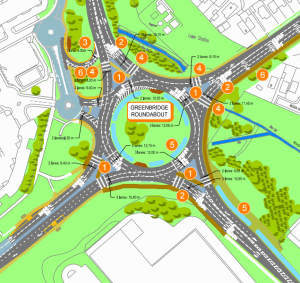
Almost simultaneously to the start of the Wolvercote Roundabout improvement works Swindon Borough Council started working on one of the town’s major roundabouts, the Greenbridge one.   To all intent and purpose it’s a very similar layout to the Wolvercote one, see picture, and the cost is more or less the same (£4m ca for Greenbridge and £9m for two roundabouts in Oxford).  

Greenbridge roundabout
Greenbridge roundabout plans

But there is a huge difference. If you travel into Swindon at rush hour you’d barely be affected by the works.  Lanes have been left open in all directions and repairs proceed at lightening speed.  As early as 7 am there will be workmen beavering away and progress is noticeable from one day to the next.

Try travelling at rush hour using Wolvercote roundabout… and as for work progress many people have taken the trouble to write to the Council and to the local papers describing the speed of work as an embarrassment.

Before you ask, both authorities are Tory led , so there is no difference in their political make up either.   When it comes to transport infrastructure we must be down at the bottom of the pile.  People often complain to us of how poorly maintained roads are once they get into Oxfordshire, as for buses and other public transport we all know well the kind of predicament we are in. 

Draw your own conclusions…

More than 20,000 extra cars?


Will our roads cope with the estimated traffic that additional housing developments planned for parts of our District could bring?

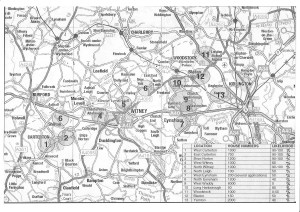
WOT officials have mapped potential housing developments alongside the A40 corridor.  We are aware that while some of these are certain to go ahead, others are still very much in planning and may therefore not even be developed, but the situation is certainly very worrying.

Even assuming that ‘only’ half of the developments in the map below went ahead this represents approximately 8000 new dwellings, or, 12,000 extra cars on our roads. How can we expect the existing infrastructure to cope with such surge in demand?  

A great deal of these new developments are sited close to the A40 (take Carterton, or West Witney for example) and are therefore fully reliant on that road.

We have little doubt in our minds that we need a long-term, reliable public transport solution.  If we just waited for the houses to be built it would way too late and would also end up costing us a lot more.  Why can’t we start planning long-term now?

A40 housing developments planned
Possible housing developments

Roads at breaking point – don’t panic!

So Ian Hudspeth the Chairman of the County Council is now saying that “We are at breaking point” and that “we should use public transport more”.  This is quite  something coming from a Council that has in the past consistently ignored public transport.

For years, and despite comparatively modest subsidies, the Council has silently been chipping away at public transport routes, particularly rural bus links, as well as neglecting long term strategies on the grounds of costs.  Now we are simply reaping the rewards of this strategy.  Our roads can’t cope any longer, the A40 in particular.  Yet hundreds of houses – apparently – will need to be built outside Oxford, thus adding to existing traffic and to the misery of daily commuting in and out of the city, without any additional infrastructure, except perhaps the odd junction improvement.

Suddenly the Leader of the Council has realised that you could reduce congestion by using public transport and has urged us to use what little of it we have got left.  Pity though that buses have to share the same congested space as cars and that there are as yet no real alternatives, like light railways or tramways, to relieve overcrowding and provide reliable transport links.  As for suggesting to use Long Hanborough station the newly extended car park is virtually full, its platform couldn’t cope with additional passengers at peak times, neighbouring roads would require urgent improvements  and, without substantial rail investment, no further trains could be run on that line.  So much for a viable alternative.

So what to do?  Well, for a start we should stop burying our heads in the sand, recognising that at least for the sake of good transport planning anything within a 15 miles radius of Oxford (give or take a few miles) should be classified as being part of a unified metropolitan area.  This approach would require a dramatic paradigm shift, but could focus planners and politicians into creating a truly integrated transport network.

In some parts of this ‘greater Oxford area’ a variety of actions may be required, from road improvements (perhaps more Park and Ride facilities), to newly built dedicated public transport links.  This can be done.  It just needs the humility to admit that we can’t continue as now and that we desperately need a long term strategic approach, backed by substantial investment of course.  And on this final point it seems that we can always find money to fund new ways of killing each other, or find very large sums to deliver massive infrastructural projects like HS2 when we really want to. Why can’t we find adequate resources for decent public transport, when we can demonstrate that  these investments could even encourage a more thriving local economy? Beside, as polls have consistently shown, if you provide full clarity, apportion taxation fairly and allocate these funds to specific schemes people are willing to pay more for this kind of long term solutions.  It just needs guts and long term vision.

Maurizio Fantato

(my own opinions not necessarily those of WOT)

Press release January 15

Imaginative ideas to reduce gridlock on A40

Witney, 16 January 2014

Local councillors and transport campaigners in Oxfordshire are backing plans for a new investigation into the growing problem of gridlock on the A40.  Bus and rail supporters have joined forces with politicians at the launch campaign of the Witney Oxford Transport (WOT) group, held in Witney on Wednesday 15 January in a packed auditorium at the High Street Methodist Church.

They’re demanding a formal assessment of alternative routes – including the possibility of re-opening a disused railway.  Witney’s growing population and the expansion of RAF Brize Norton have added pressure to the already congested A40.

The launch meeting of WOT ended with a unanimous call for a new study of the problems and possible solutions. Among the ideas being considered:

1. A Metro-style commuter train service between Cowley and Witney using existing lines and a section of disused track axed during the Beeching era of the 1960s.

2. A guided busway – a new concrete road exclusively used by buses. A similar system has recently opened in Cambridge.

3. A revolutionary “Tramtrain” service where European-style trams operate over existing and formerly abandoned rail lines.

Hugh Jaeger of the transport campaign group Bus Users UK said: “We are completely open-minded about the alternative, but one thing is absolutely certain – we can’t afford to do nothing.”

ENDS