Urgent Transport Solutions Needed for West Oxfordshire – the line that never was

More consultations!

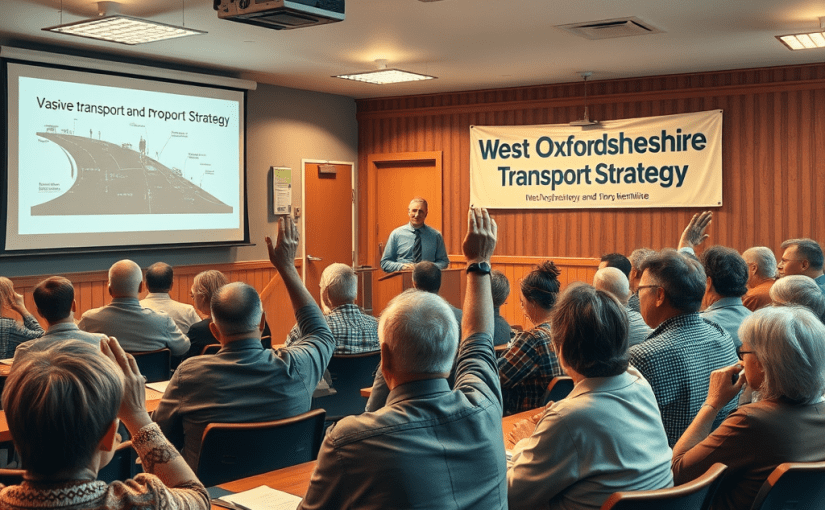
On Monday, 22 September, Oxfordshire County Council held a meeting with stakeholders to present its latest transport strategy for the county. For West Oxfordshire residents hoping for concrete progress, the session was a familiar disappointment.

The information released wasn’t momentous – it simply brought together existing proposals under a single approach: expanding Banbury, the cross-country line to Cambridge, a couple of stations here and there (like Wantage, which has been discussed for the last 30 years), and doubling the first part of the Cotswold line.

The meeting was clearly a tick-box exercise rather than a genuine consultation. Allowing for the usual speaker overruns, the actual Q&A session squeezed in just six questions over ten minutes from a 90-minute programme.

West Oxfordshire: The Black Hole

Most notable was the absence of firm proposals for West Oxfordshire. Except for a brief presentation at the end, showing a red line described as “an opportunity for intermodal transport still under discussion,” West Oxfordshire remained a black hole in the county’s approach, dismissed with vague mentions of “more consultations needed.”

What these consultations could possibly reveal that isn’t already known is a mystery. Twenty-five years ago, transport consultants Mott MacDonald delivered a clear warning to the council. Unless the A40 is dualled and a rail link is provided between Oxford and Witney, there would be serious negative consequences for the area’s development.

Twenty-Five Years of Inaction

A quarter-century and two separate consultants’ reports screaming for urgent action later, what do we have to show for it? A new park and ride facility outside Eynsham, which stands empty and inaccessible to road users and is costing us £10,000 every month in maintenance. While the Shores Green bypass will provide some relief to Witney, it won’t meet the exponential growth in housing planned across the area over the next decade.

More recent reports commissioned by the council concluded that without additional transport links, the area would be gridlocked by 2030. By the time more houses are built, retrofitting roads or rail becomes even more expensive.

A Glimmer of Hope

There’s a faint possibility that enlightened developers might compensate for the Council’s inertia and realise that severe infrastructure deficits could devalue their investments. Acting together, they might support solutions – perhaps even a rail link to the new Park & Ride. But in the current economic climate, hope is slim.

The Time for Action is Now

The choice is clear: accept another 25 years of inaction, or lobby the council and all local politicians to demand real solutions. 

The 16,000 new homes planned for our area are expected to generate over 32,000 additional daily car journeys without alternative and sustainable transport means, and living standards in our District will degrade. We cannot afford to be left behind.

Don’t let West Oxfordshire remain the county’s forgotten corner. Join our campaign for a railway from Oxford to Witney and Carterton before it is too late (witneyoxfordtransport.org.uk).
Let’s work together – update from WOT Group’s Chair

Taken as a whole, Carterton, Witney and Eynsham and the surrounding villages represent one of the largest populations in the country not connected to the rail network. The poor transport links in the district generate many negatives including reduced access to employment and education; deterring employers from locating locally; slow, stressful and unpredictable journeys; and increased pollution.  We believe that a rail line would help West Oxfordshire and the county as a whole to prosper by providing a fast corridor along which people can rapidly and sustainably move, providing West Oxfordshire residents far greater access to job and education opportunities.

Given the layout of Oxford with single lane roads leading into the centre and a very congested ring road, it’s clear that the fastest way both into Oxford and around Oxford is by rail.  See here for a Google Earth presentation outlining a potential route, connecting into the Cotswold Line at Yarnton.  A restored rail line would cut journey times enormously, with trains running from Eynsham to Oxford in 9 minutes, Witney to Oxford in 16 minutes and Carterton to Oxford in 22 minutes. This would substantially reduce congestion on the A40 and take a material number of cars off the road. The rail line will also enable fast travel beyond Oxford, whether it is continuing on along the Cowley line (post conversion from freight to passenger traffic) to the business and science parks southeast of the city; or to other regional centres such as Didcot, Bicester, Bletchley; or to London, Birmingham or along the upcoming East-West Rail link to Cambridge.

Photo by Ju00c9SHOOTS on Pexels.com

Some people think that if we just stick with really bad infrastructure that we won’t get more housebuilding in the district, but that’s wrong.  As per the District’s Local Plan (see p46), the District Council has committed to building 10,450 new homes in the district between 2021 and 2031. This is at the national and county government’s command, so we are getting the houses whether we like it or not. Being realistic, 2031 will not be the end of housebuilding in the district. Importantly, this is all happening irrespective of whether a train line is built or not. Therefore we have the choice, either to stick our heads in the sand and hope it will all go away, or we can decide to take control to the maximum extent possible and create infrastructure which is fast, sustainable and serves our needs as residents. The planned bus express lanes for four miles from a park & ride at Eynsham to Wolvercote roundabout will help, but they are unlikely to make more than a minimal difference to overall journey times given they make up a small fraction of the 17 miles by road from Oxford to Carterton and that the road congestion in Oxford and Witney will be unchanged.

Many of us talk about a climate emergency. Here is an opportunity to do something about it.  Transport is the single biggest producer of greenhouse gas emissions in West Oxfordshire, with road transport comprising 98% of transport emissions in the District. We are advocating a clean energy solution, most likely battery powered. This is not pie in the sky, battery powered trains are in commercial production now.  The advantages of battery power include zero pollutants, zero direct CO2 emissions, no overhead wires and very quiet running.

When making decisions we need to think not just about the next three, five or ten years, but what makes sense over the next twenty, fifty or one hundred years.  We also need to go step by step.  Witney Oxford Transport Group is submitting an application to the Department for Transport’s Restoring Your Railways Ideas Fund by March 5th for a £50,000 grant to fund a feasibility study. To date, we have received letters of support for this bid from Witney Town Council, Carterton Town Council, Eynsham Parish Council, the Lord Mayor of Oxford, Oxford University and Grosvenor, the developer of the Eynsham Garden Village.  We’re thrilled and very grateful to have their support. However, most of all, we want to hear from everyone who lives in the district. The Witney Gazette and Witney Radio have kindly offered to run a survey this week and here is the link – https://www.surveymonkey.com/r/WitneyOxfordTransportGroup. The shortest version is just two questions, but if you can fill in all ten, even better.  Either way, it’s very short and we beg you both to fill it in and please circulate it as widely as possible!

A tale of two roundabouts

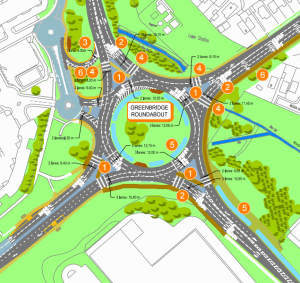
Almost simultaneously to the start of the Wolvercote Roundabout improvement works Swindon Borough Council started working on one of the town’s major roundabouts, the Greenbridge one.   To all intent and purpose it’s a very similar layout to the Wolvercote one, see picture, and the cost is more or less the same (£4m ca for Greenbridge and £9m for two roundabouts in Oxford).  

Greenbridge roundabout
Greenbridge roundabout plans

But there is a huge difference. If you travel into Swindon at rush hour you’d barely be affected by the works.  Lanes have been left open in all directions and repairs proceed at lightening speed.  As early as 7 am there will be workmen beavering away and progress is noticeable from one day to the next.

Try travelling at rush hour using Wolvercote roundabout… and as for work progress many people have taken the trouble to write to the Council and to the local papers describing the speed of work as an embarrassment.

Before you ask, both authorities are Tory led , so there is no difference in their political make up either.   When it comes to transport infrastructure we must be down at the bottom of the pile.  People often complain to us of how poorly maintained roads are once they get into Oxfordshire, as for buses and other public transport we all know well the kind of predicament we are in. 

Draw your own conclusions…