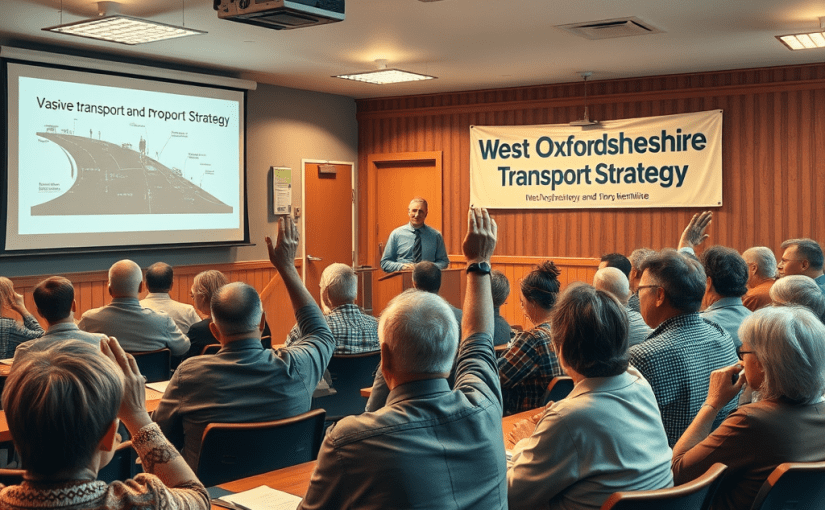
On Monday, 22 September, Oxfordshire County Council held a meeting with stakeholders to present its latest transport strategy for the county. For West Oxfordshire residents hoping for concrete progress, the session was a familiar disappointment.
The information released wasn’t momentous – it simply brought together existing proposals under a single approach: expanding Banbury, the cross-country line to Cambridge, a couple of stations here and there (like Wantage, which has been discussed for the last 30 years), and doubling the first part of the Cotswold line.
The meeting was clearly a tick-box exercise rather than a genuine consultation. Allowing for the usual speaker overruns, the actual Q&A session squeezed in just six questions over ten minutes from a 90-minute programme.
West Oxfordshire: The Black Hole
Most notable was the absence of firm proposals for West Oxfordshire. Except for a brief presentation at the end, showing a red line described as “an opportunity for intermodal transport still under discussion,” West Oxfordshire remained a black hole in the county’s approach, dismissed with vague mentions of “more consultations needed.”
What these consultations could possibly reveal that isn’t already known is a mystery. Twenty-five years ago, transport consultants Mott MacDonald delivered a clear warning to the council. Unless the A40 is dualled and a rail link is provided between Oxford and Witney, there would be serious negative consequences for the area’s development.
Twenty-Five Years of Inaction
A quarter-century and two separate consultants’ reports screaming for urgent action later, what do we have to show for it? A new park and ride facility outside Eynsham, which stands empty and inaccessible to road users and is costing us £10,000 every month in maintenance. While the Shores Green bypass will provide some relief to Witney, it won’t meet the exponential growth in housing planned across the area over the next decade.
More recent reports commissioned by the council concluded that without additional transport links, the area would be gridlocked by 2030. By the time more houses are built, retrofitting roads or rail becomes even more expensive.
A Glimmer of Hope
There’s a faint possibility that enlightened developers might compensate for the Council’s inertia and realise that severe infrastructure deficits could devalue their investments. Acting together, they might support solutions – perhaps even a rail link to the new Park & Ride. But in the current economic climate, hope is slim.
The Time for Action is Now
The choice is clear: accept another 25 years of inaction, or lobby the council and all local politicians to demand real solutions.
The 16,000 new homes planned for our area are expected to generate over 32,000 additional daily car journeys without alternative and sustainable transport means, and living standards in our District will degrade. We cannot afford to be left behind.
Don’t let West Oxfordshire remain the county’s forgotten corner. Join our campaign for a railway from Oxford to Witney and Carterton before it is too late (witneyoxfordtransport.org.uk).
As you may have seen, Oxfordshire County Council has launched a consultation on OxRail 2040: Plan for Rail. This is our chance to shape the future of transport in our county for the next 15 years.
Here in West Oxfordshire, we face some of the worst congestion in the county. The Government has required thousands of new houses to be built locally, but we still have no railway serving Carterton, Witney, or Eynsham. Without action, the traffic problems on the A40 and beyond will only get worse.
That’s why it’s so crucial that the Council hears loud and clear from residents that we want the Carterton–Witney–Oxford railway restored. The consultation explicitly includes the proposal to revive the railway, but we need to demonstrate overwhelming public support to ensure it happens.
You can use the following text in your email, tweak it as much as you like, or just use it as inspiration for your own words. Just copy and paste into the text field on your email client:
I am writing as a resident of Oxfordshire to respond to the OxRAIL 2040: Plan for Rail consultation.
I firmly support the overarching ‘case for change’ and vision of this plan. Improving our rail network will have a range of positive outcomes, from supporting and spreading the benefits of economic growth through sustainable access to jobs and homes, to aiding our transition to net zero, and enhancing the inclusivity and connectedness of our communities. I do, however, want to ensure that within the next 15 years these benefits can be felt by many more residents of West Oxfordshire too.
West Oxfordshire’s communities and businesses are significantly underserved by the rail network, with the most populated and rapidly growing corridor in the southern part of the district not served by rail services at all. Indeed, as the Technical Evidence Base itself notes, “Most of our larger population centres ….. are close to our rail network, notable exceptions to this are Carterton and Witney.” I therefore note with approval the commitment given in Phase 1, 2025-30, to continue development of a proposed scheme to reconnect Carterton, Witney and Eynsham with Oxford. That must, however, be matched by unequivocal commitments to bringing the rail line to Witney and Carterton as well, to work towards securing completion of the new link by the end of the 15-year Plan period.
West Oxfordshire’s roads are already at capacity. Congestion on the Witney-Oxford stretch of the A40 is renowned for being particularly bad. A county council-commissioned study by AECOM in 2021 found that, even with the then-predicted increase in local housing, Witney-Oxford car travel will take 30 minutes longer by as early as 2031. Since then, planned housing growth in West Oxfordshire is now required by central government to be 65% higher than previously and the forecast express bus lanes linking Eynsham with Oxford are not funded.
While the consultation document refers to the need for a “mass rapid transit system” in West Oxfordshire, the county council’s own feasibility study published in November 2023 evidenced that a rail system is the higher-capacity, faster, greener, and more reliable solution than any other option. Restoring regular rail services across the southern part of West Oxfordshire would reduce future journey times between Carterton and Oxford, for example, by an hour, with a Witney-Oxford journey time of just 16 minutes. The rail line would also support the creation of new jobs and the sustainability of planned housing growth, or ‘place-making’ as it’s called, reducing carbon emissions and saving a million car miles a year. A Network Rail Western Route study last year showed Witney as 19th and Carterton 45th of the most significant unconnected population clusters among hundreds across the whole of Britain, with them ranked respectively fourth equal then sixth-highest of the 23 places studied in Western Route for ‘strategic fit’ – which speaks volumes about the justification and urgent need for a railway to connect them with Oxford.
Protection measures: Stronger policies preventing development that could compromise the route
The A40 corridor faces severe congestion, which is expected to worsen with the planned expansion of housing. Rail is essential for sustainable transport and achieving the Plan’s net-zero objectives.
Core Policy 3 – Spatial Strategy
Question: “Do you support the spatial strategy focusing growth along the A40 corridor?”
WOT Response: Witney Oxford Transport supports concentrating growth along the A40 corridor, but emphasises that this requires rail infrastructure to be sustainable.
The strategy correctly identifies the A40 corridor as a key growth area; however, the current transport infrastructure is already under severe pressure. Without a Carterton-Witney-Oxford rail link:
16,000 new homes will generate approximately 32,000 additional car journeys daily
A40 congestion will become gridlock, undermining the economic benefits of growth
Net-zero transport objectives cannot be achieved
We recommend:
Making rail delivery a prerequisite for significant A40 corridor developments
Requiring transport impact assessments to include rail alternatives
Phasing development to align with rail infrastructure delivery
The spatial strategy is sound but needs rail to be deliverable and sustainable.
Core Policy 1 – Climate Change
Question: How can the climate change policy be strengthened?
WOT Response: The climate policy must explicitly recognise transport infrastructure as essential for emission reductions.
Current gaps:
Focus on building emissions, but limited attention to transport infrastructure
No specific targets for reducing transport modal share
Insufficient emphasis on public transport delivery
Recommended additions:
Target: Reduce private car dependency by 25% by 2035 through public transport
Requirement: Major developments must demonstrate a contribution to sustainable transport infrastructure
Recognition: Rail infrastructure as a climate change mitigation measure equivalent to renewable energy
The Carterton-Witney-Oxford rail link would:
Remove at least 2,000 car journeys daily from the A40
Reduce transport emissions by 15% across the corridor
Enable modal shift essential for net-zero targets Without rail, WODC Plan’s climate objectives are unachievable.
Core Policy 4 – Delivering New Homes
Question: Do you support the housing delivery strategy?
WOT Response: “The housing numbers are challenging but achievable if supported by appropriate transport infrastructure.
Key concerns:
16,000 new homes without rail will create transport chaos
Focus on housing delivery speed may override infrastructure planning
Risk of piecemeal development that doesn’t integrate with rail plans
Essential requirements:
Strategic sites (300+ homes) must contribute to rail infrastructure through S106 agreements
Phasing policies to ensure transport infrastructure keeps pace with housing
Integration requirements – all A40 corridor sites must demonstrate rail compatibility
We support the 10% buffer for flexibility but recommend:
Part of this buffer should be contingent on rail delivery
Use flexibility to ensure infrastructure-led development
Housing growth is positive but must be transport-sustainable to avoid creating new problems.
Settlement Strategies – Witney
Question: Comments on the Witney settlement strategy?
WOT Response: “The Witney strategy correctly identifies transport as the town’s most significant challenge but needs stronger rail commitments.
We strongly support:
Recognition of A40 congestion as a major constraint Sustainable transport as a strategic objective
Bridge Street bottleneck acknowledgment
Critical additions needed:
Rail Delivery Timeline – When Will the Oxford Link Be Restored?
Integration Requirements – How Will New Developments Support Rail?
Traffic reduction targets – specific goals for modal shift
Recommended policy additions:
All significant Witney developments must include rail contribution requirements
Transport assessments must model rail alternatives
New developments should be accessible to future rail stations
Without rail, Witney’s growth strategy will fail due to transport constraints. The strategy needs rail to be deliverable.
Settlement Strategies – Carterton
Question: Comments on the Carterton settlement strategy?
WOT Response: “The Carterton strategy’s transformational growth vision is excellent but absolutely requires rail delivery.
Strong support for:
Recognition of rail as essential for economic potential A40 access improvements
Strategic employment growth vision, including the development of RAF Brize Norton
Critical implementation points:
‘Transformational’ growth cannot happen without rail – this must be explicit. The Timeline for rail delivery should align with housing phases
Significant developments should contribute proportionally to the rail infrastructure
Specific recommendations:
Require rail feasibility contributions from developments over 100 homes
Include rail accessibility in site selection criteria
Phase growth to ensure rail delivers before peak housing completions
Carterton has enormous potential, but this potential is entirely dependent on solving transport connectivity. Rail isn’t optional – it’s essential.
Policy DM20 – Town Centres
Question: Comments on town centre policies?
WOT Response: “Town centre vitality depends on accessibility – rail is essential for both Witney and Carterton centres.
Current challenges:
Parking constraints limit town centre access
Car dependency undermines sustainability goals
Competition from Oxford/Bicester requires better connectivity
Rail benefits for town centres:
Direct access from Oxford brings customers without parking needs
Reduced traffic improves pedestrian environment
Economic multiplier – rail stations become economic anchors
Policy recommendations:
Include rail accessibility as a town centre vitality factor
Require pedestrian/cycle links from future stations to centres
Plan station-adjacent development to support town centre economy
Strong town centres need sustainable transport access – rail is the key to long-term vitality.
Policy DM24 – Active and Healthy Travel
Question: Comments on active travel policy?
WOT Response: “Excellent policy that needs rail integration to maximise effectiveness.
Strong support for:
Active travel prioritization
Integration with development Network connectivity focus
Essential addition:
Rail stations should be active travel hubs with:
Secure cycle parking (minimum 100 spaces per station)
Walking/cycling routes connecting stations to residential areas
Integration with bus services and car clubs
Recommended policy addition:
Significant developments within 2km of planned rail routes must provide direct active travel connections to future stations
Active travel assessments should include rail station accessibility
Active travel and rail are complementary – together they can achieve the modal shift needed for sustainability.
General Economic Benefits
Question: How can the Plan better support economic development?
WOT Response: “Rail infrastructure is economic infrastructure – essential for West Oxfordshire’s economic future.
Economic benefits of rail:
£2.4 billion economic impact over 30 years (typical rail project multiplier)
4,000+ jobs during construction phase
Reduced business costs – employees can live locally without car commuting
Inward investment – businesses locate near good transport links
Relieve pressure on overstretched Oxford resources
Tourism boost – sustainable access to Cotswolds attractions
Policy recommendations:
Include rail in economic development policies
Require economic impact assessments to include rail benefits Consider rail a strategic economic asset like employment land
Evidence base: Every £1 invested in rail typically generates £4 in economic benefits. Rail isn’t just transport – it’s economic development infrastructure.
Infrastructure and Viability
Question: Comments on infrastructure delivery and viability?
WOT Response: “Infrastructure delivery policies must prioritise strategic transport alongside utilities.”
Key points:
Rail infrastructure serves multiple developments, more cost-effective than individual site solutions
Cumulative contributions from A40 corridor developments can fund rail delivery
Viability assessments should include long-term transport costs
Recommended mechanism:
Community Infrastructure Levy (CIL) specifically for rail infrastructure
S106 contributions scaled to development size and transport impact
Pooled funding approach rather than site-by-site assessment
Economic argument: Rail infrastructure increases land values and development viability long-term. Initial contributions are investments in sustainable growth, not costs.
Key Consultation Questions WODC needs to address:
How will Policy PL5 be implemented? We request specific mechanisms and timescales.
What developer contributions will fund rail infrastructure?
Ensure coordination with central housing allocations?
What safeguards exist against piecemeal development? We must protect corridor integrity.
The Cadenza report is a remarkable document, less about transport along the overcrowded corridor from Oxford to the West than about the economic and social prospects of West Oxfordshire. It is a long and detailed report that has gone largely unread by those who are quick to be shocked by how much a railway will cost and slow to realise that the railway now offers the only realistic way to avoid economic stagnation in West Oxfordshire.
Cadenza notes that the problem of the A40 in West Oxfordshire is now so severe that the usual approach to its solution is no longer appropriate. The usual approach is to build ever more new houses along the A40 corridor, the only route westwards from Oxford, hoping that developers and one level or another of government will then pay for the infrastructure required to make living in the new houses practicable. It is estimated that the population of West Oxfordshire will grow by 19% between 2018 and 2028, and infrastructure growth has not kept pace. Transport is the most laggardly and regularly tops the list of issues infuriating the local electorate. But developers tend to renege on their promises, as do governments, given the challenges presented by election cycles. The typical transport project is a disjointed selection of inefficient, ineffective and expensive roadworks. The Cadenza report observes that infrastructure must precede housing and that a railway – and only a railway – can guarantee infrastructure delivery before housing delivery.
There are no other options.
Inherent in the usual approach to the A40 problem is a desultory debate on alternatives to the road. Suggestions of a cable car between Witney and Oxford or moving pavements only distract from more serious options. Cadenza rapidly disposes of the least impractical of these: technical problems render the North Cotswold line unable to relieve pressure on the A40, there is no tram network to which an A40 tram could link without digging up many of Oxford’s streets, and a bus service is restricted by congestion on the road. Little is heard these days of Oxfordshire Connect, the County Council’s master plan, which scarcely considered the A40 corridor and seems to have fallen victim to the electoral cycle. Every few years, a storm of public indignation at decades of congestion on the A40 is mollified by the promise of a new junction here, a bit of dualling there, or a few hundred meters of bus lane. It can always be shown that tinkering with the roadway has a favourable benefit: cost ratio – at least for a while.
The Cadenza report is scathing about this usual approach and the crisis it has produced. From 2031, congestion on the A40 will make West Oxfordshire not just less rich but actually poorer. Regional deterioration is anticipated as employers go elsewhere, jobs are lost, and houses stand empty, much like the shops already abandoned on our high streets. Cadenza argues that this benefit:cost approach focussed on the A40 is impoverishing the region:
The combination of rising demand within the highly constrained transport corridor of the A40 is set to reach practical capacity by about 2031, by which time journey time and reliability will be so poor that it is likely to have a significantly detrimental impact on the economies of Carterton, Witney, Eynsham and Oxford. (para 8.6.1)
Cadenza goes further; what is required is not simply a solution to a transport problem but an ‘economic enabler’ capable of reversing the economic and social decline of West Oxfordshire:
… what has become clear in examining this proposal is that it is not solely a rail, or even a transport, scheme. Improvements in the A40 corridor are an economic enabler in the Oxford area…
Par 7.1 Cadenza
The report pulls no punches, making clear that doing nothing (or next to nothing) is not an option.
… the do nothing option leads to strongly negative outcomes … the real costs of decline through economic and social stagnation will become more and more apparent over time.
Para 7.7 Cadenza
… do nothing … implies a significant and likely unacceptable reduction in economic activity if local residents cannot access employment or have to disrupt family life in order to take advantage of acceptable car journey speeds only available at anti-social times of day.
Para 7.7 Cadenza
It is unfair to castigate the usual approach to the A40 problem as doing absolutely or nearly nothing. Rather the usual approach should be seen as doing enough for the moment.
More roads?
Road improvements to ease traffic congestion tend to attract even more vehicles, thus resurrecting the problem they were supposed to solve. The current roadworks on the A40, the bus lanes and the park and ride at Eynsham will be overwhelmed by congestion by 2031 – and they are not even in operation yet. The roadworks will delay gridlock for a few years, when more sticking plaster will be required. The usual approach satisfies no one for long, it is disruptive and extremely expensive.
… there is no ‘do-nothing’ option: failure to act will lead to negative economic outcomes, and alternative means of avoiding these (e.g. road improvements) are of a similar order of magnitude of cost.
Para 8.1 Cadenza
Whereas most transport schemes benefit from marginal journey time improvements, the real benefit of this scheme is that of an economic enabler, unlocking sustainable development and jobs that are unlikely to exist without it. More than that, a failure to begin the process of enabling transport capacity and resilience in the A40 corridor is likely to steadily starve both Oxford and the West Oxfordshire towns of affordable homes and accessible jobs. (para 7.8)
The Cadenza report is clear that the usual approach has become fundamentally and dangerously wrong. The congestion anticipated by 2031 (the report estimates that morning peak journey times from Witney to Oxford will be 30 minutes longer by then and that buses will be operating at economic and practical capacity) will be so serious that it will not be enough for local politicians to show they are addressing the problem, which always means tinkering with the road.
An alternative highways-based strategy to meet capacity would require significant further A40 widening or an additional major road, which would cost a similar amount to the railway but be more disruptive to construct, increase parking problems in Oxford, conflict with OCC policy to reduce car travel and be unable to provide the capacity or journey time benefits a railway would bring. (para 8.6.4)
Rail advantages.
West Oxfordshire has advantages to offer a railway but not other modes of travel. Having its three largest settlements in a line is no small advantage – but only if there is to be a railway. Having a population wealthy enough to afford land value capture for ready access to efficient transport is a huge advantage – but only if there is to be a railway and if local authorities establish where stations are to be in time for developers to exact a charge. A further advantage is that the heavy rail that provides serious public transport can also connect to the existing rail network and that the battery-powered trains recommended in the Cadenza report will go some way towards meeting the council’s greenhouse obligations. But these advantages have to be seized if West Oxfordshire is to avoid economic decline:
A railway would provide the capacity and journey times that would make living in Carterton / Witney / Eynsham and working (or studying, etc.) in Oxford a viable and sustainable way of life. Businesses could then invest in Oxford or the three towns knowing that employees could reliably and quickly get to work. In turn, that would unlock land for sustainable development to meet the needs for affordable housing, adding land value which could be used in part to support the delivery of the railway and economic value to Oxfordshire, which is widely considered an unaffordable place to live for many (para 8.5)
Put bluntly, whatever a railway costs will be less than the cost of not having a railway: The gross cost of constructing a railway is therefore not the appropriate cost to put in an appraisal – one needs to net off the costs of not doing a railway, as opposed to ‘doing nothing’, as well as taking into account the expected contribution from Land Value Capture resulting from the increase in accessibility. (para 7.3.1)
Rail costs – the same as new roads!
The all-in cost of heavy rail along the A40 corridor is estimated to be something like £900 million. At about £35.6 million per route kilometre, this is the same order of magnitude as the current A40 works package, likely to be overwhelmed by congestion shortly after completion.
Cadenza calculates that an extra 600 jobs and land value capture – the former facilitated by the railway and the latter possible only with a railway – would pay for the railway’s construction:
… just 600 jobs plus LVC could potentially deliver the highest cost railway scheme … (para 7.8)
The stretch from Oxford to Eynsham could be completed by 2033, just about in time to compensate for the failure of the current A40 roadworks, with full connection from Oxford to Carterton from 2035. A reliable half-hourly service is anticipated as are journey times currently almost unimaginable:
23 January 2021 – today we received the encouraging news that the Minister for Rail, Chris Heaton-Harris, views the Witney to Oxford railway line as a suitable project for consideration by the Restoring Your Railways Ideas Fund. This fund was created for organisations like WOT, seeking to develop proposals for the restoration of long-lost railway branches. The Fund’s submission deadline is March 5, with grants of £50,000 awarded to successful applicants to help fund feasibility studies.
Mr Heaton-Harris, Minister for Rail, told reporters at the Oxford Mail that the Witney to Oxford line, long promoted as a potential commuter branch line, would be ideal for this fund. He went on saying: “That is exactly the sort of thing we are looking at, areas where we can make a difference with not too big sums of money.”
Charlie Maynard, Chairman of WOT, said: “We are hugely encouraged by the expressions of support for our project over the last few weeks. This endorsement is a big step forward for our campaign. Our district is much in need of a comprehensive public transport solution and this is a key step in the right direction”.
Today we have written to all man parties candidates. Here is the copy of the message. As soon as we receive a reply we’ll post it on this site – keep an eye!
Dear (candidate name)
We are the Witney Oxford Transport (WOT) campaign, a cross party group set up in 2013 to address the issue of traffic alongside the A40 corridor, from Carterton and neighbouring areas into Oxford.
It will come as no surprise to you that traffic congestion on the A40 has increased over the last ten years making journeys between our district and Oxford unpredictable. In addition, several thousand houses are planned in the area. With Oxford acting as the main economic focus for the county and the cost of housing in that city being unaffordable to most people, it is natural to expect a substantial increase in traffic on the only main artery we have, the A40, which is already at breaking point.
We are fully aware of recent plans proposed by the County Council and the LEP to ameliorate the situation but we are of the opinion that although welcome they are insufficient to address the problem and a new more radical, sustainable and long-term vision is required instead.
We are now gathering information from all candidates in order to address these questions which are of interest to our members:
Would you support the creation of an alternative transport mode, either as a light rail or similar, to serve the area in question, joining it up with the rest of the network?
Would you be willing to look again at the development plans for the area, lobbying for the creation of a well planned and state of art housing approach, rather than a piecemeal one as we have now?
Would you be willing to consider rural regeneration plans that would create affordable and sustainable carbon neutral communities instead of conventional housing through a partnership of the private and public sectors?
How would you support the growth of areas like Carterton and Brize Norton as high-tech centres for the District?
I look forward to hearing from you and will be glad to share your views with other Witney voters through WOT (Witney Oxford Transport), the pressure group that campaigns for reliable transport from Oxford to the west of the county. Yours sincerely
Summing up the WOT “Unblocking the A40” Seminar, 10 November, Oxford
If you have been following our campaign you couldn’t have missed the seminar we organised a couple of weeks ago in Oxford. Before, during and after the event we received a number of questions and we thought it would be useful to address some of these issues in a Q&A format (the questions have been re-edited as several were similar):
Why did you organise this event in Oxford and not in Witney?
Two fundamental reasons. The first is that traffic alongside the A40 is both ways and it affects people in Oxford too. The second is eminently practical. We had speakers and guests travelling by train and there was simply no way they could have come to a public venue on time in Witney. Those who commute from Oxford to Witney daily will know what we are talking about. There was nothing more complex or sinister in the decision and the majority of our regular meetings are held in the Carterton/Witney/Eynsham areas.
How did you select the speakers?
We wanted to bring in a range of expertise and visions. Ray provided the urban planner expertise, as well as his own joined up vision of a regional approach that might even go beyond our local stretch of the A40. Roger came from one of our funders, Railfuture, to offer us his own perception of how these things work in terms of looking at strategic partnerships, as well as looking at opportunities in view of recent legislative changes. Finally we couldn’t have wished for a better overall public transport expert with Stephen from CBT (Campaign for Better Transport) and his huge knowledge of these matters not only at local but also international level.
What did you want to achieve?
In a year which has seen fundamental shifts in this country’s political and economic landscape you could forgive our key stakeholders for taking their eyes off the ball, with the risk that more time would be wasted before anything was done to alleviate the situation. A public meeting was our way of telling them that we are very much in the business of ensuring this problem should continue to be a top priority. Furthermore, we also wanted to demonstrate that what we had brought to the table on previous occasions and in several semi-private meetings at council and district level was also backed by the public and by even more experts. Lastly, we simply need the support of as many people and local organisations as possible to achieve our objectives. It would have been unrealistic to have set more specific goals, like expecting to have total agreement for a specific solution. The debate itself demonstrated the variety of interests and approaches.
Are the presentations available?
Yes, just go on the Past Events page and you will be able to download a PDF of each of the two presentations (there were no Powerpoint slides from Roger).
What are you planning to do next?
We are planning to organise a summit of all local parish councils in the new year during which we will discuss more specific details of our approach as well as exchanging information on some highly technical issues related to the proposed short term improvements to the A40
Do you favour a specific solution?
Many of us see a public transport option (rail or similar) as the best possible alternative. We are not naturally opposed to the dualling of the A40, but we simply do not think that this alone could possibly provide a solution. The travel pattern in our District is just too complex and, just as a mere example, even 15 years ago the County council wanted to dual the A40 *and* create a parallel public transport link all the way from Witney to Oxford. If there was such need back then we could easily argue this is even more urgent now.
Right now our main concern is that any land where the old rail link was sited is safeguarded. Once the land is built up it would be much more difficult to reclaim it. So it must be protected together with its essential infrastructure such as bridges and so on.
Why public transport?
There are two good reasons. The first is strategic. You can’t just rely on a simple transport mode. You couldn’t have just a few roads going from Bristol to London and no other form of transport. It would have engendered chaos and stifled economic growth. So we need an alternative. Public transport of the right kind, where vehicles follow their own independent tracks, is reliable by definition as a customer can plan a journey and reach their destinations within set times. Everyone who uses trains, metros or the London river boats know this. You know the time your service will pass by your stop and when you will reach your destination.
Do you have any documentation?
We have amassed a very large library of documents, from the original Mott Macdonald report to more recent ones and more. Just drop us a line for information.
Are your regular meeting public?
Yes. We meet at least monthly and mainly at Freeland Parish Hall. We publish the meeting dates on Facebook and on our website. Everyone is welcome to attend.
How can we get in touch?
Easy. Just drop us a line or follow us on our social media channels.
The editor of the Oxford Mail has recently added his voice to the chorus of concern on local transport when it was reported that the previous day it had taken commuters over three hours to reach Oxford from Witney.
For those who are commuting daily on that route the misery has only exacerbated due to a combination of crumbling infrastructure, roadworks around Oxford and simply increased traffic. Matters will not improve substantially either by simply extending a junction or adding a new lane here and there. Oxfordshire, and West Oxfordshire in particular, has been starved of real investments for far too long.
Council planners had identified potential problems way back in 2001, yet thirteen years later we are still waiting for a solution. It has now become an emergency.
Quick fix risk
The risk now is that officials may be tempted to rush into a quick fix, throwing a few millions here and there, not enough for a well planned long term solution, but just sufficient for palliative measures. We cannot afford to go down that road. We don’t need a sticky plaster, but a robust and future proof transport infrastructure project.
While we have always advocated an agnostic approach to transport modes we cannot remain silent when we see that things are heading in the wrong direction. There are non negotiable elements to any transport plans for our region and these are:
Reliability and proven track record
Sustainability
Integration with other transport modes
Low visual impact
Proven ROI over a medium/long term period
The next few months will be crucial. Expect a flurry of interest especially as we approach general elections. Expect some harebrained proposals too, as the smell of big money will inevitably attract unscrupulous entrepreneurs. If you feel strongly about what we stand for join us so that we can have an even louder voice on the decision making process.
 Witney Oxford Transport Group
You must be logged in to post a comment.