On Monday, 22 September, Oxfordshire County Council held a meeting with stakeholders to present its latest transport strategy for the county. For West Oxfordshire residents hoping for concrete progress, the session was a familiar disappointment.
The information released wasn’t momentous – it simply brought together existing proposals under a single approach: expanding Banbury, the cross-country line to Cambridge, a couple of stations here and there (like Wantage, which has been discussed for the last 30 years), and doubling the first part of the Cotswold line.
The meeting was clearly a tick-box exercise rather than a genuine consultation. Allowing for the usual speaker overruns, the actual Q&A session squeezed in just six questions over ten minutes from a 90-minute programme.
West Oxfordshire: The Black Hole
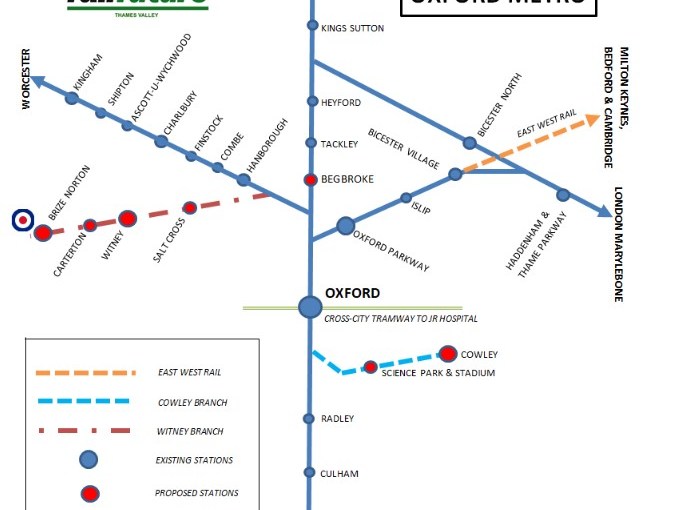
Most notable was the absence of firm proposals for West Oxfordshire. Except for a brief presentation at the end, showing a red line described as “an opportunity for intermodal transport still under discussion,” West Oxfordshire remained a black hole in the county’s approach, dismissed with vague mentions of “more consultations needed.”
What these consultations could possibly reveal that isn’t already known is a mystery. Twenty-five years ago, transport consultants Mott MacDonald delivered a clear warning to the council. Unless the A40 is dualled and a rail link is provided between Oxford and Witney, there would be serious negative consequences for the area’s development.
Twenty-Five Years of Inaction
A quarter-century and two separate consultants’ reports screaming for urgent action later, what do we have to show for it? A new park and ride facility outside Eynsham, which stands empty and inaccessible to road users and is costing us £10,000 every month in maintenance. While the Shores Green bypass will provide some relief to Witney, it won’t meet the exponential growth in housing planned across the area over the next decade.
More recent reports commissioned by the council concluded that without additional transport links, the area would be gridlocked by 2030. By the time more houses are built, retrofitting roads or rail becomes even more expensive.
A Glimmer of Hope
There’s a faint possibility that enlightened developers might compensate for the Council’s inertia and realise that severe infrastructure deficits could devalue their investments. Acting together, they might support solutions – perhaps even a rail link to the new Park & Ride. But in the current economic climate, hope is slim.
The Time for Action is Now
The choice is clear: accept another 25 years of inaction, or lobby the council and all local politicians to demand real solutions.
The 16,000 new homes planned for our area are expected to generate over 32,000 additional daily car journeys without alternative and sustainable transport means, and living standards in our District will degrade. We cannot afford to be left behind.
Don’t let West Oxfordshire remain the county’s forgotten corner. Join our campaign for a railway from Oxford to Witney and Carterton before it is too late (witneyoxfordtransport.org.uk).
Protection measures: Stronger policies preventing development that could compromise the route
The A40 corridor faces severe congestion, which is expected to worsen with the planned expansion of housing. Rail is essential for sustainable transport and achieving the Plan’s net-zero objectives.
Core Policy 3 – Spatial Strategy
Question: “Do you support the spatial strategy focusing growth along the A40 corridor?”
WOT Response: Witney Oxford Transport supports concentrating growth along the A40 corridor, but emphasises that this requires rail infrastructure to be sustainable.
The strategy correctly identifies the A40 corridor as a key growth area; however, the current transport infrastructure is already under severe pressure. Without a Carterton-Witney-Oxford rail link:
16,000 new homes will generate approximately 32,000 additional car journeys daily
A40 congestion will become gridlock, undermining the economic benefits of growth
Net-zero transport objectives cannot be achieved
We recommend:
Making rail delivery a prerequisite for significant A40 corridor developments
Requiring transport impact assessments to include rail alternatives
Phasing development to align with rail infrastructure delivery
The spatial strategy is sound but needs rail to be deliverable and sustainable.
Core Policy 1 – Climate Change
Question: How can the climate change policy be strengthened?
WOT Response: The climate policy must explicitly recognise transport infrastructure as essential for emission reductions.
Current gaps:
Focus on building emissions, but limited attention to transport infrastructure
No specific targets for reducing transport modal share
Insufficient emphasis on public transport delivery
Recommended additions:
Target: Reduce private car dependency by 25% by 2035 through public transport
Requirement: Major developments must demonstrate a contribution to sustainable transport infrastructure
Recognition: Rail infrastructure as a climate change mitigation measure equivalent to renewable energy
The Carterton-Witney-Oxford rail link would:
Remove at least 2,000 car journeys daily from the A40
Reduce transport emissions by 15% across the corridor
Enable modal shift essential for net-zero targets Without rail, WODC Plan’s climate objectives are unachievable.
Core Policy 4 – Delivering New Homes
Question: Do you support the housing delivery strategy?
WOT Response: “The housing numbers are challenging but achievable if supported by appropriate transport infrastructure.
Key concerns:
16,000 new homes without rail will create transport chaos
Focus on housing delivery speed may override infrastructure planning
Risk of piecemeal development that doesn’t integrate with rail plans
Essential requirements:
Strategic sites (300+ homes) must contribute to rail infrastructure through S106 agreements
Phasing policies to ensure transport infrastructure keeps pace with housing
Integration requirements – all A40 corridor sites must demonstrate rail compatibility
We support the 10% buffer for flexibility but recommend:
Part of this buffer should be contingent on rail delivery
Use flexibility to ensure infrastructure-led development
Housing growth is positive but must be transport-sustainable to avoid creating new problems.
Settlement Strategies – Witney
Question: Comments on the Witney settlement strategy?
WOT Response: “The Witney strategy correctly identifies transport as the town’s most significant challenge but needs stronger rail commitments.
We strongly support:
Recognition of A40 congestion as a major constraint Sustainable transport as a strategic objective
Bridge Street bottleneck acknowledgment
Critical additions needed:
Rail Delivery Timeline – When Will the Oxford Link Be Restored?
Integration Requirements – How Will New Developments Support Rail?
Traffic reduction targets – specific goals for modal shift
Recommended policy additions:
All significant Witney developments must include rail contribution requirements
Transport assessments must model rail alternatives
New developments should be accessible to future rail stations
Without rail, Witney’s growth strategy will fail due to transport constraints. The strategy needs rail to be deliverable.
Settlement Strategies – Carterton
Question: Comments on the Carterton settlement strategy?
WOT Response: “The Carterton strategy’s transformational growth vision is excellent but absolutely requires rail delivery.
Strong support for:
Recognition of rail as essential for economic potential A40 access improvements
Strategic employment growth vision, including the development of RAF Brize Norton
Critical implementation points:
‘Transformational’ growth cannot happen without rail – this must be explicit. The Timeline for rail delivery should align with housing phases
Significant developments should contribute proportionally to the rail infrastructure
Specific recommendations:
Require rail feasibility contributions from developments over 100 homes
Include rail accessibility in site selection criteria
Phase growth to ensure rail delivers before peak housing completions
Carterton has enormous potential, but this potential is entirely dependent on solving transport connectivity. Rail isn’t optional – it’s essential.
Policy DM20 – Town Centres
Question: Comments on town centre policies?
WOT Response: “Town centre vitality depends on accessibility – rail is essential for both Witney and Carterton centres.
Current challenges:
Parking constraints limit town centre access
Car dependency undermines sustainability goals
Competition from Oxford/Bicester requires better connectivity
Rail benefits for town centres:
Direct access from Oxford brings customers without parking needs
Reduced traffic improves pedestrian environment
Economic multiplier – rail stations become economic anchors
Policy recommendations:
Include rail accessibility as a town centre vitality factor
Require pedestrian/cycle links from future stations to centres
Plan station-adjacent development to support town centre economy
Strong town centres need sustainable transport access – rail is the key to long-term vitality.
Policy DM24 – Active and Healthy Travel
Question: Comments on active travel policy?
WOT Response: “Excellent policy that needs rail integration to maximise effectiveness.
Strong support for:
Active travel prioritization
Integration with development Network connectivity focus
Essential addition:
Rail stations should be active travel hubs with:
Secure cycle parking (minimum 100 spaces per station)
Walking/cycling routes connecting stations to residential areas
Integration with bus services and car clubs
Recommended policy addition:
Significant developments within 2km of planned rail routes must provide direct active travel connections to future stations
Active travel assessments should include rail station accessibility
Active travel and rail are complementary – together they can achieve the modal shift needed for sustainability.
General Economic Benefits
Question: How can the Plan better support economic development?
WOT Response: “Rail infrastructure is economic infrastructure – essential for West Oxfordshire’s economic future.
Economic benefits of rail:
£2.4 billion economic impact over 30 years (typical rail project multiplier)
4,000+ jobs during construction phase
Reduced business costs – employees can live locally without car commuting
Inward investment – businesses locate near good transport links
Relieve pressure on overstretched Oxford resources
Tourism boost – sustainable access to Cotswolds attractions
Policy recommendations:
Include rail in economic development policies
Require economic impact assessments to include rail benefits Consider rail a strategic economic asset like employment land
Evidence base: Every £1 invested in rail typically generates £4 in economic benefits. Rail isn’t just transport – it’s economic development infrastructure.
Infrastructure and Viability
Question: Comments on infrastructure delivery and viability?
WOT Response: “Infrastructure delivery policies must prioritise strategic transport alongside utilities.”
Key points:
Rail infrastructure serves multiple developments, more cost-effective than individual site solutions
Cumulative contributions from A40 corridor developments can fund rail delivery
Viability assessments should include long-term transport costs
Recommended mechanism:
Community Infrastructure Levy (CIL) specifically for rail infrastructure
S106 contributions scaled to development size and transport impact
Pooled funding approach rather than site-by-site assessment
Economic argument: Rail infrastructure increases land values and development viability long-term. Initial contributions are investments in sustainable growth, not costs.
Key Consultation Questions WODC needs to address:
How will Policy PL5 be implemented? We request specific mechanisms and timescales.
What developer contributions will fund rail infrastructure?
Ensure coordination with central housing allocations?
What safeguards exist against piecemeal development? We must protect corridor integrity.
The Cadenza report is a remarkable document, less about transport along the overcrowded corridor from Oxford to the West than about the economic and social prospects of West Oxfordshire. It is a long and detailed report that has gone largely unread by those who are quick to be shocked by how much a railway will cost and slow to realise that the railway now offers the only realistic way to avoid economic stagnation in West Oxfordshire.
Cadenza notes that the problem of the A40 in West Oxfordshire is now so severe that the usual approach to its solution is no longer appropriate. The usual approach is to build ever more new houses along the A40 corridor, the only route westwards from Oxford, hoping that developers and one level or another of government will then pay for the infrastructure required to make living in the new houses practicable. It is estimated that the population of West Oxfordshire will grow by 19% between 2018 and 2028, and infrastructure growth has not kept pace. Transport is the most laggardly and regularly tops the list of issues infuriating the local electorate. But developers tend to renege on their promises, as do governments, given the challenges presented by election cycles. The typical transport project is a disjointed selection of inefficient, ineffective and expensive roadworks. The Cadenza report observes that infrastructure must precede housing and that a railway – and only a railway – can guarantee infrastructure delivery before housing delivery.
There are no other options.
Inherent in the usual approach to the A40 problem is a desultory debate on alternatives to the road. Suggestions of a cable car between Witney and Oxford or moving pavements only distract from more serious options. Cadenza rapidly disposes of the least impractical of these: technical problems render the North Cotswold line unable to relieve pressure on the A40, there is no tram network to which an A40 tram could link without digging up many of Oxford’s streets, and a bus service is restricted by congestion on the road. Little is heard these days of Oxfordshire Connect, the County Council’s master plan, which scarcely considered the A40 corridor and seems to have fallen victim to the electoral cycle. Every few years, a storm of public indignation at decades of congestion on the A40 is mollified by the promise of a new junction here, a bit of dualling there, or a few hundred meters of bus lane. It can always be shown that tinkering with the roadway has a favourable benefit: cost ratio – at least for a while.
The Cadenza report is scathing about this usual approach and the crisis it has produced. From 2031, congestion on the A40 will make West Oxfordshire not just less rich but actually poorer. Regional deterioration is anticipated as employers go elsewhere, jobs are lost, and houses stand empty, much like the shops already abandoned on our high streets. Cadenza argues that this benefit:cost approach focussed on the A40 is impoverishing the region:
The combination of rising demand within the highly constrained transport corridor of the A40 is set to reach practical capacity by about 2031, by which time journey time and reliability will be so poor that it is likely to have a significantly detrimental impact on the economies of Carterton, Witney, Eynsham and Oxford. (para 8.6.1)
Cadenza goes further; what is required is not simply a solution to a transport problem but an ‘economic enabler’ capable of reversing the economic and social decline of West Oxfordshire:
… what has become clear in examining this proposal is that it is not solely a rail, or even a transport, scheme. Improvements in the A40 corridor are an economic enabler in the Oxford area…
Par 7.1 Cadenza
The report pulls no punches, making clear that doing nothing (or next to nothing) is not an option.
… the do nothing option leads to strongly negative outcomes … the real costs of decline through economic and social stagnation will become more and more apparent over time.
Para 7.7 Cadenza
… do nothing … implies a significant and likely unacceptable reduction in economic activity if local residents cannot access employment or have to disrupt family life in order to take advantage of acceptable car journey speeds only available at anti-social times of day.
Para 7.7 Cadenza
It is unfair to castigate the usual approach to the A40 problem as doing absolutely or nearly nothing. Rather the usual approach should be seen as doing enough for the moment.
More roads?
Road improvements to ease traffic congestion tend to attract even more vehicles, thus resurrecting the problem they were supposed to solve. The current roadworks on the A40, the bus lanes and the park and ride at Eynsham will be overwhelmed by congestion by 2031 – and they are not even in operation yet. The roadworks will delay gridlock for a few years, when more sticking plaster will be required. The usual approach satisfies no one for long, it is disruptive and extremely expensive.
… there is no ‘do-nothing’ option: failure to act will lead to negative economic outcomes, and alternative means of avoiding these (e.g. road improvements) are of a similar order of magnitude of cost.
Para 8.1 Cadenza
Whereas most transport schemes benefit from marginal journey time improvements, the real benefit of this scheme is that of an economic enabler, unlocking sustainable development and jobs that are unlikely to exist without it. More than that, a failure to begin the process of enabling transport capacity and resilience in the A40 corridor is likely to steadily starve both Oxford and the West Oxfordshire towns of affordable homes and accessible jobs. (para 7.8)
The Cadenza report is clear that the usual approach has become fundamentally and dangerously wrong. The congestion anticipated by 2031 (the report estimates that morning peak journey times from Witney to Oxford will be 30 minutes longer by then and that buses will be operating at economic and practical capacity) will be so serious that it will not be enough for local politicians to show they are addressing the problem, which always means tinkering with the road.
An alternative highways-based strategy to meet capacity would require significant further A40 widening or an additional major road, which would cost a similar amount to the railway but be more disruptive to construct, increase parking problems in Oxford, conflict with OCC policy to reduce car travel and be unable to provide the capacity or journey time benefits a railway would bring. (para 8.6.4)
Rail advantages.
West Oxfordshire has advantages to offer a railway but not other modes of travel. Having its three largest settlements in a line is no small advantage – but only if there is to be a railway. Having a population wealthy enough to afford land value capture for ready access to efficient transport is a huge advantage – but only if there is to be a railway and if local authorities establish where stations are to be in time for developers to exact a charge. A further advantage is that the heavy rail that provides serious public transport can also connect to the existing rail network and that the battery-powered trains recommended in the Cadenza report will go some way towards meeting the council’s greenhouse obligations. But these advantages have to be seized if West Oxfordshire is to avoid economic decline:
A railway would provide the capacity and journey times that would make living in Carterton / Witney / Eynsham and working (or studying, etc.) in Oxford a viable and sustainable way of life. Businesses could then invest in Oxford or the three towns knowing that employees could reliably and quickly get to work. In turn, that would unlock land for sustainable development to meet the needs for affordable housing, adding land value which could be used in part to support the delivery of the railway and economic value to Oxfordshire, which is widely considered an unaffordable place to live for many (para 8.5)
Put bluntly, whatever a railway costs will be less than the cost of not having a railway: The gross cost of constructing a railway is therefore not the appropriate cost to put in an appraisal – one needs to net off the costs of not doing a railway, as opposed to ‘doing nothing’, as well as taking into account the expected contribution from Land Value Capture resulting from the increase in accessibility. (para 7.3.1)
Rail costs – the same as new roads!
The all-in cost of heavy rail along the A40 corridor is estimated to be something like £900 million. At about £35.6 million per route kilometre, this is the same order of magnitude as the current A40 works package, likely to be overwhelmed by congestion shortly after completion.
Cadenza calculates that an extra 600 jobs and land value capture – the former facilitated by the railway and the latter possible only with a railway – would pay for the railway’s construction:
… just 600 jobs plus LVC could potentially deliver the highest cost railway scheme … (para 7.8)
The stretch from Oxford to Eynsham could be completed by 2033, just about in time to compensate for the failure of the current A40 roadworks, with full connection from Oxford to Carterton from 2035. A reliable half-hourly service is anticipated as are journey times currently almost unimaginable:
You can be forgiven for thinking that we went underground over the last few months and clearly, our activities were also greatly affected by the pandemic. However, despite all the restrictions, our Chair, Charlie Maynard, continued to lobby all our local politicians relentlessly, and we finally see the fruits of our labour.
At a meeting on January 18th, Oxfordshire County Council (“OCC”) Cabinet approved funding for a feasibility study of the Oxford-Eynsham-Witney-Carterton railway line. We are immensely pleased to report that the funds were finally sanctioned by the Council’s Budget Meeting on February 8th. OCC will now fund and lead this project, conducted by an appointed consulting firm specialising in this sector.
Why is a feasibility study important?
The Department for Transport’s standard Strategic Outline Business Case approach considers the Business, Strategic, Economic, Financial and Management merits of each rail project. Without this information, DfT and the other stakeholders would not be able to reach an appropriate decision. The study would be conducted by an independent professional rail consultant and would typically be completed in three months. With that work in hand, everyone will be in a much better position to properly assess the project, the economic, social and environmental benefits it would bring, and gain a much more detailed view of the estimated costs and timeline.
WOT worked tirelessly to get to this point, funding two studies in 2021. One commissioned SLC Rail to consider route options around Eynsham, taking into account the A40 expansion programme and two significant planned developments to the north and west of Eynsham. The second study was commissioned by WOT with E-Rail to explore how Land Value Capture funding could be applied to this project, along similar lines to what E-Rail achieved on the Northumberland Line. These studies were shared with OCC personnel and helped provide them with essential background information to consider funding the Feasibility Study in question. All the analyses were funded thanks to some generous personal donations to WOT. Our reserves are generally in the hundreds rather than thousand pounds, and we are operating with a minimal number of volunteers.
Where do we go from here?
During our consultations, we were given added determination by the extreme local popularity of our proposal. A survey indicated that 97% of respondents supported completing a feasibility study. Obviously, so many residents feel that a rail link between Carterton and Oxford would help relieve the dreadful congestion on the A40, reducing pollution, including CO2 emissions and opening up many other opportunities.
The feasibility study is now a big step ahead as it will provide hard evidence to all parties, to be used to determine the way forward.
Eventually, a rail link from Witney to Oxford could take just 16 minutes. A modern and forward-looking proposal like ours would see the creation of multimodal hubs, integrating effectively with other transport modes like bicycles, local buses and more. WOT’s vision is to deliver a fast, sustainable and reliable transport solution to West Oxfordshire, which helps the District economically, socially and environmentally.
The planned A40 works through Eynsham will block off the best, and possibly the only viable rail route to Witney and Carterton – if the works proceed as proposed.
The Preliminary Planning phase started last month and runs to August. It is critical that this phase makes provision for a future rail route.
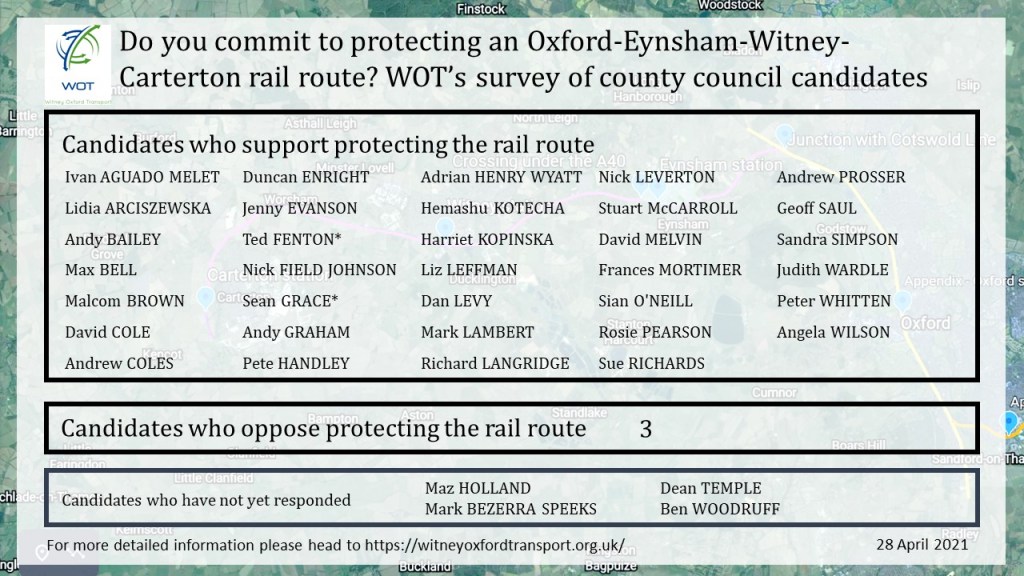
The May 6th local elections will be held in two weeks’ time. WOT has approached local candidates asking them to pledge to preserve a rail link with a simple question: “do you support defining and protecting a rail route as an integral part of the planned A40 Works project and will you vote in support of this at Council meetings?”
So far, 83 candidates have pledged their support and only 3 candidates oppose. For full details of candidates’ views, please see below.
We are very pleased to have such overwhelming support from candidates across all political parties. This reflects both WOT Group’s cross-party background and our ongoing survey of West Oxfordshire residents which found that 97% of 864 respondents support exploring the potential of restoring the railway line, with 94% stating that they are likely to use it.
We are following up with the remaining candidates and will provide further updates leading up to the elections. In the meantime you can view the results here, and below:
If you are a candidate and would like to either amend the entry or contribute to it please send us the relevant information to Contact Us
Write to your County Council election candidate – County Council Elections
As customary many organisations and community groups write to their candidates at election times to clarify their position on a specific issue. Our main concern at this present time is for the preservation of a possible rail route alongside the A40 and we are now sharing with you what we have written to them. You too can help us out by copying and pasting the body of the letter below, sending it to your local candidate!
Request to your candidate – copy as required:
WOT Group is very supportive of the A40 Works and Eynsham Park & Ride projects, with the key caveat that the projects make passive provision for a future rail route. We are therefore writing to each county and district candidate to understand whether:
“you support defining and protecting a rail route as an integral part of the planned A40 Works project and will you vote in support of this at Council meetings?”
Without this protection it is almost certain that a future rail route will be blocked, which is clearly not in the interests of West Oxfordshire’s communities. Please could you let us know whether you support or oppose making the above commitment. A list of the responses (Yes/No/No reply) will be made available in our website and other social media channels.
Further background to our proposal below:
Protecting the Rail Route – the A40 Works Project and Eynsham Park & Ride
Approximately seven miles of the A40 are set to be dualled, from Hill Farm, halfway between Witney and Eynsham, to the Wolvercote roundabout on Oxford’s ring road. The section west of Eynsham will be dual carriageway; the section east of Eynsham will also be dual carriageway, but with bus lanes running in each direction, connecting into a new Park & Ride to be built at Eynsham. The funding is in place for this and the work is due to be completed by Q3 2024. WOT Group fully supports the A40 Works and Eynsham Park & Ride projects, with the critical caveat that the Council does indeed stand by its 2015 commitment and ensure that these works do not physically block off a future railway line.
This easterly section of the Oxford-Carterton rail route is particularly important for three reasons. It is the section that connects Oxford to Witney; no railway line can reach Witney without this section being built. Secondly, it is the section most under threat, if the planned A40 Works do not protect a rail route. Finally, it is where 3,200 houses will be built in the next few years. If this railway line is built, there will be a substantial uplift in land values of these new homes, which will generate quite a windfall of the developers. We are focused on mechanisms which allow a portion of that gain, which will only occur if the railway is built, to fund the railway. In a best case scenario, that will take some of the burden off the taxpayer and will allow that first section of track to be built quicker.
Oxfordshire County Council (“OCC”) has written a letter of support for our bid to the DfT’s Restoring Your Railways Ideas Fund bid. Additionally, as per the 2015 Local Transport Plan, the Council has committed to “retain the option of a rail line to Witney as a longer term aspiration in its A40 Strategy, and will pursue opportunities to realise the aspiration”.
On March 8th 2021, the Eynsham Park & Ride application was approved on the basis that the Park & Ride neither impinged nor stopped any future rail investment and that this project would be complementary to a future rail line. However, while the OCC team is in agreement that there is space within the 8.8ha Park & Ride facility for a future railway station, no plans have been made either as to how a rail station would fit into the future Park & Ride facility, or to define and protect a rail route along the A40 Works. This is unusual, and without doing this it is highly likely that these planned works will indeed block a future rail route. This urgently needs to be remedied.
The 8.8 hectare planned Park & Ride is by far most suitable place for a future Eynsham railway station, as: 1) it is on the A40, so can take traffic directly from the road, 2) it is located in the central point between the existing village, the 2,200 houses planned for Salt Cross Garden Village and the 1,000 houses planned in the West Eynsham development, 3) it will have up to 850 car parking spaces, and 4) county officers have confirmed that there is space inside the Park & Ride for a rail station.
A rail corridor is only ten metres wide. The A40 has space, either directly to the north or south of the road along all of its length, into which expansion is possible. Around Eynsham, Grosvenor have independently kept a buffer along the southern edge of the Garden Village project for “future transport needs”. So yes, there is space into which an integrated road, rail and bike corridor can be fitted.
While we would all like the railway to be built quickly and there are clear synergies from these projects being managed together, the above issue is an entirely separate issue from when the railway will be built. It is about ensuring that a viable route is planned for, defined and protected so that a railway can be built on a cost efficient basis in the future. The preliminary design phase for the A40 Works started in March 2021 and is due to run to August 2021, when a planning application is due to be submitted. Public consultations have not yet even begun, and are planned for May and June 2021. So no, it’s not too late.
Local elections are on May 6th. We will be asking all county and district candidates to stand by the commitment made to in the 2015 Local Plan and to support defining and protecting a rail route as part of the A40 Works. We will shortly be publishing a list of those pledges so everyone has that information available when it comes to choosing their candidate.
Need to know who your candidate is?
Just go to Who Can I Vote For here enter your postcode to access the list of local candidates. If you still need any help please Contact Us.
Building a better-connected West Oxfordshire – a transformational project for the wider Oxford economic region.
Excerpt from the Introduction:
A rail line would link Oxford with the two largest towns in West Oxfordshire – Witney (population 28,800 in 2017) and Carterton (population 16,500 in 2017) – and with Eynsham, where the population is forecast to more than double by 2030, from 5,000 in 2017. These communities have been, and continue to be, heavily reliant on the chronically congested A40. This has been the case ever since they lost their passenger rail services in June 1962. Please see here for an indicative overview of the potential rail route.
Our core proposition would be two trains per hour at least in the weekday peak periods running between Carterton and Oxford. Refining service levels, frequencies and timetabling will be a key focus of the feasibility work, including exploring opportunities to link into the national rail network for journeys to Oxford and beyond (Banbury, Bicester, Bletchley, Cowley, Culham, Didcot, etc).
Infrastructure requirements – c.15 miles of new single track over either flat or gently undulating terrain from a new junction currently assumed to be with the Cotswold Line near Yarnton (c.4.5 miles from Oxford station), via Eynsham and Witney, to a terminus station at Carterton. The safeguarded formation should be able to accommodate future service frequency growth by allowing for selective doubling using a passing loop or loops whether between or within stations (as for example at Penryn on the Falmouth line), with this all to be refined in the feasibility work on timetabling. RAF Brize Norton is a confirmed supporter of a feasibility study covering both passenger and freight options. A substantial Park & Ride transport hub at Eynsham with 1,000 car parking spaces is currently in advanced planning stages. There is a good opportunity for this to become a multi-modal hub including a rail station. This site could also serve a parkway function for the A40, maximising line patronage and modal shift.
The survey run in conjunction with the Witney Gazette and Witney Radio couple of weeks ago resulted in a resounding YES for a new rail link between Oxford and Witney. Here are some of the figures:
97% are in support of “exploring the potential of restoring a railway line that connects the communities of Carterton, Witney and Eynsham with Oxford”.
74% stated that they are “very likely” to use the new rail link, with 13% stating “likely” and 7% “somewhat likely”, a total of 95% (94.6%, pre-rounding).
Fast and accessible public transport was ranked as the most important issue for 44% of respondents, with this issue ranking in the top three for 85%
For more information or the full details of the survey (750 respondents) please follow this link.
Taken as a whole, Carterton, Witney and Eynsham and the surrounding villages represent one of the largest populations in the country not connected to the rail network. The poor transport links in the district generate many negatives including reduced access to employment and education; deterring employers from locating locally; slow, stressful and unpredictable journeys; and increased pollution. We believe that a rail line would help West Oxfordshire and the county as a whole to prosper by providing a fast corridor along which people can rapidly and sustainably move, providing West Oxfordshire residents far greater access to job and education opportunities.
Given the layout of Oxford with single lane roads leading into the centre and a very congested ring road, it’s clear that the fastest way both into Oxford and around Oxford is by rail. See here for a Google Earth presentation outlining a potential route, connecting into the Cotswold Line at Yarnton. A restored rail line would cut journey times enormously, with trains running from Eynsham to Oxford in 9 minutes, Witney to Oxford in 16 minutes and Carterton to Oxford in 22 minutes. This would substantially reduce congestion on the A40 and take a material number of cars off the road. The rail line will also enable fast travel beyond Oxford, whether it is continuing on along the Cowley line (post conversion from freight to passenger traffic) to the business and science parks southeast of the city; or to other regional centres such as Didcot, Bicester, Bletchley; or to London, Birmingham or along the upcoming East-West Rail link to Cambridge.
Some people think that if we just stick with really bad infrastructure that we won’t get more housebuilding in the district, but that’s wrong. As per the District’s Local Plan (see p46), the District Council has committed to building 10,450 new homes in the district between 2021 and 2031. This is at the national and county government’s command, so we are getting the houses whether we like it or not. Being realistic, 2031 will not be the end of housebuilding in the district. Importantly, this is all happening irrespective of whether a train line is built or not. Therefore we have the choice, either to stick our heads in the sand and hope it will all go away, or we can decide to take control to the maximum extent possible and create infrastructure which is fast, sustainable and serves our needs as residents. The planned bus express lanes for four miles from a park & ride at Eynsham to Wolvercote roundabout will help, but they are unlikely to make more than a minimal difference to overall journey times given they make up a small fraction of the 17 miles by road from Oxford to Carterton and that the road congestion in Oxford and Witney will be unchanged.
Many of us talk about a climate emergency. Here is an opportunity to do something about it. Transport is the single biggest producer of greenhouse gas emissions in West Oxfordshire, with road transport comprising 98% of transport emissions in the District. We are advocating a clean energy solution, most likely battery powered. This is not pie in the sky, battery powered trains are in commercial production now. The advantages of battery power include zero pollutants, zero direct CO2 emissions, no overhead wires and very quiet running.
When making decisions we need to think not just about the next three, five or ten years, but what makes sense over the next twenty, fifty or one hundred years. We also need to go step by step. Witney Oxford Transport Group is submitting an application to the Department for Transport’s Restoring Your Railways Ideas Fund by March 5th for a £50,000 grant to fund a feasibility study. To date, we have received letters of support for this bid from Witney Town Council, Carterton Town Council, Eynsham Parish Council, the Lord Mayor of Oxford, Oxford University and Grosvenor, the developer of the Eynsham Garden Village. We’re thrilled and very grateful to have their support. However, most of all, we want to hear from everyone who lives in the district. The Witney Gazette and Witney Radio have kindly offered to run a survey this week and here is the link – https://www.surveymonkey.com/r/WitneyOxfordTransportGroup. The shortest version is just two questions, but if you can fill in all ten, even better. Either way, it’s very short and we beg you both to fill it in and please circulate it as widely as possible!

 Witney Oxford Transport Group
You must be logged in to post a comment.